Thursday, 25 August 2011

UKM TECH....


UKM Technology Sdn. Bhd. (UKMT) combines the activities of technology transfer, company incubation and investment. UKMT provides services to help academic researchers commercialise new technologies discovered at UKM. It licenses patents and know-how to other companies to be commercially exploited, and it also helps creates start-up companies to capitalise on new discoveries.
The services include:
  1. technology sourcing
  2. commercial property management
  3. market analysis
  4. formation of new University technology-based start-up companies
  5. technology licensing
  6. incubation services and space
  7. investment and venture capital
LINK :

Brief History of the Evolution of the School of Industrial Technology

The School commenced with the establishment of the School of Applied Sciences, which offered the Bachelor of Applied Sciences (BAppSc) programme in 1973. Three programmes were offered at the beginning, i.e. : Electronic Science and Technology, Food Science and Technology and Polymer Science and Technology. During the 1974/1975 academic session, a fourth programme, i.e. Mineral Science and Technology was introduced. The fifth programme, i.e. Computer Science and Technology was introduced in the 1979/1980 academic session.On 7th August 1984, the School of Applied Sciences was renamed as the School of Engineering Sciences and Industrial Technology. In line with this change, the curriculum was also modified to meet the requirement of engineering and industrial technology courses. Bachelor of Applied Science (BAppSc) was replaced by Bachelor of Engineering (BEng.) and Bachelor of Technology (B.Tech).
 
During the 1986/1987 session, the School of Engineering Sciences and Industrial Technology were separated. The School of Industrial Technology remained in the main campus, Penang while the School of Electrical and Electronic Engineering and the School of Materials and Mineral Resources Engineering moved to Perak Branch Campus.


Beginning with the 2001/2002 academic session, the Polymer Technology Programme and Quality Control & Instrumentation Programme moved to the USM Branch Campus in Sri Ampangan, Nibong Tebal. The Polymer Technology Programme was changed to the Polymer Engineering Programme and was located under the School of Materials and Mineral Resources Engineering. The Quality Control & Instrumentation Programme was renamed as the Mechatronic Engineering Programme and located under the School of Electrical and Electronic Engineering.

During the 2002/2003 academic session, the Wood, Paper and Coatings Technology Programme was renamed as the Bioresource, Paper and Coatings Technology Programme. Bioprocess Technology Programme is the latest addition to the existing three Programmes in the School beginning form 2008/2009 academic session.

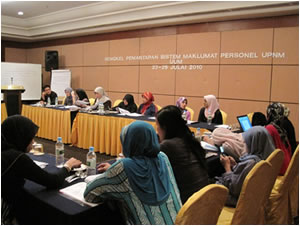
UPNM System

Integrated Development Of An Information System Project Nasional Defence University's Information Malaysia (SMU-UPNM) have began to be implemented on Pintar UUM-UPNM partnership concept from September 2007. In this project, UPNM party desire to carry university integrated development of an information system or in short SMU-UPNM as both party beginning UUM and UPNM foster other collaboration that tighter in academic activity. UUM-UPNM party agree to develop SMU-UPNM which contains systems following:

i.) Sistem Akadmik Pelajar (SAP)                                   
ii.) Sistem maklumat personal (SMP)
iii.) Sistem Portal Universiti (Mycampus)
iv.) Penghantaran Data KPT
v.) Smartcard System

UUM agreed to help UPNM develop application system entailment and modify the application for UPNM use.
That system shall be exercised by UPNM and used as basis to extend function and the role in supporting UPNM activity further. UPNM party would take steps to protect copyright software that supplied by UUM through spirit of intelligent partnership.


SMU-UPNM OBJECTIVE

-Launched administration duties by keep staff information and student with faster, right and safe.
-Reduce consumer work load with way accelerate staff information access and student at anytime.
-Provide report quickly and right to users.
-Supply student information and staff to other systems to back consumer parties information requirement.


Tuesday, 9 August 2011

UNIK'S ECOSYSTEM AND WEALTH CREATION INTIATIVES


PUTRAJAYA, 19 April. -Dato’ Seri NajibTun Razak today announced 23 ecosystem and wealth creation initiatives which will attract billions of ringgit in investment from the nation’s intellectual wealth.

He also witnessed the strategic alliance signing between the respective partners and Unit InovasiKhas (UNIK), which comes under the purview of Prime Minister’s Office to commercialise the ventures and reiterated that innovation is an integral component of the Government’s aim and objectives in laying the foundation for Malaysia, 2021 and beyond.

UNIK is a one-stop centre to formulate policies and strategies aimed at creating a conducive ecosystem to propel development and innovation in Malaysia.

Eight projects that originated from research at public universities provided a glimpse of the expertise that lies among Malaysian scientists and more “gems” are expected to be discovered and commercialised.
The innovation eco-system projects launched would create the environment for innovation to thrive and prosper, benefitting sectors such as education, higher education, industry and entrepreneurship.

The projects have been divided into three categories-New Wealth Creation, Intellectual Property from Universities & Public Research Institutes and Eco-System Initiatives.
Under the New wealth Creation segment there is one Strategic Impact Project which is the Oil Palm Biomass roadmap to Malaysia and four Ground-Up projects – electricity from every window, energy dashboard for energy management for the future, enabling small business to go cash- less and cutting edge technology for the LED industry. The global market for this sector is estimated to be US$472 billion (RM1.46 trillion).
Initiatives and collaborations with Universities and Public Research Institutes includes project from The Wireless Communication Centre (WCC), UniversitiTeknologi Malaysia (UTM) called an Innovative, compact and elegant Flat Antenna to replace bulky and inefficient parabolic antennas.
The improved performance characteristics include: High gain and efficiency; Low profile, compact and elegant construction design flush against roof or wall; and suitable for satellite and ground based communications. Its applications include: a more efficient receiver for satellite signals; rural or scattered internet and wireless telephony; and long distance data, voice and video communication.
The flat antenna has been installed and demonstrated successfully on UTM’s campus with a complete monitoring system. With the assistance of Innovation and Commercialisation Centre (ICC) UTM, the flat antenna has been successfully commercialised on several locations which includes: SIRIM Bhd., UPM-MTDC. UKM-MTDC and UTM-MTDC. The global market value is estimated to be US$ 13 billion (RM 39 billion).

The others are Carbon Fibre Products by SIRIM; Painticide, developed by the Institute of Medical Research; polymerase Chain Reaction by USM; Pelvic Binder by UKM; NaturalMedicine for Cervical Cancer from UPM and Quick Diagnostic Kit for Denque from UM. The global market for the ventures initiated by universities and public research institute is  said to amount to US$101 billion (RM316 billion) globally.

Under the Eco-System is a project undertaken by the Malaysian Productivity Corporation (MPC) and UNIK to match the needs of large private companies with existing capabilities and facilities in Malaysia. 

R&Ds were conducted by five public universities and two research institutions, namely UniversitiSains Malaysia (USM), Universiti Malaya (UM), UniversitiKebangsaan Malaysia (UKM), Universiti Putra Malaysia (UPM), UniversitiTeknologi Malaysia (UTM), Sirim and Institute for Medical Research (IMR).A total of 1,100 R&D findings were submitted by the universities to UNIK , but after much analysis and shortlisting processes, only 113 were identified and 18 technologies from UTM to have high potential to be commercialised
The Prime Minister Datuk Seri Najib Tun Razak visiting UTM exhibtion booth.

Going The Distance On Cooking Oil

2011/05/24
By Syed Umar Ariff
news@nst.com.my

LINK :


JOHOR BAHRU: Have cooking oil will travel.
At least, that is what 65 students from Universiti Teknologi Malaysia and Indonesia's Universitas Tanjungpura are trying to prove on a 6,500km journey from Singapore to Laos which began on Sunday.

Yesterday, a convoy of two buses and two pick-up trucks -- fuelled with biodiesel mainly produced from used cooking oil -- was flagged off from UTM after departing from Changi Airport, Singapore.


This is UTM's third bio-diesel expedition since 2009. Previously, palm oil-based biodiesel was used for the vehicles. The university's selling point; the engines of these vehicles are not modified in any way to run on the fuel.

UTM Vice-Chancellor Prof Datuk Dr Zaini Ujang said the students would gauge the efficiency of the fuel during the 15-day trip across Singapore, Peninsular Malaysia, Thailand and Laos.

"The students will also help promote environmental awareness and study the effects of carbon emission using biodiesel," Zaini said at a press conference.


The students will also learn about the process and cost of manufacturing biodiesel from used cooking oil at a plant in Hatyai, Thailand.

"One of our objectives is to learn about biodiesel plants. The cost to set up one is around RM100 million. Tonight (last night), the convoy is expected to take a break in Berseri, Perlis before entering Thailand."

The convoy's adviser, UTM chemical engineering faculty's Associate Prof Dr Firdausi Razali said apart from researching the feasibility of cooking oil as a biofuel, the programme was also aimed at educating the public on recycling cooking oil.


"Not many people know that cooking oil can be recycled into something useful like biofuel. Most food-stall operators usually throw away the oil or sell them to be recycled into cooking oil again," said Firdausi.

And, of course, cooking oil, as a biofuel, is expected to be cheaper than palm oil -- another factor that they would look into, he added.


Vice-Chancellor Prof Datuk Dr Zaini Ujang flagging off the convoy at Universiti Teknologi Malaysia in Skudai yesterday

COLLABORATION BETWEEN UTM AND CCM CHEMICALS


Vice-Chancellor Professor Dato’ Dr Zaini Ujang said, the company has agreed to use the research products developed by the UTM researchers who have acquired intellectual property rights.
According to him, the products will be used to restore polluted water catchment areas, absorb heavy metals using natural compounds from plants, use of membranes to filter water and water purification products.
"Four research products produced by the UTM researchers which will be used by CCMC have intellectual property in the form of patents.”

"Collaboration between UTM and CCMC is a smart partnership that will provide benefits and create great impact to the chemical industry in Malaysia," he said at a Memorandum of Understanding signing ceremony in UTM today.
The Memorandum of Understanding was signed by Dr Zaini who represents UTM and CCMC by its Executive Director, Amirul Feisal Wan Zahir at UTM campus in Johor Bahru, 29 March 2011.

Zaini said, CCMC is a leading company in the chemical-based industries in the country and is listed on Bursa Malaysia. The company has expanded its business in the field of water treatment and polymer for the production of latex gloves.

"The collaboration provides an opportunity for both sides to implement staff exchange and research programs as well as the use of laboratory facilities," he said.
He said, as of today, UTM has produced 2,024 intellectual property and become the largest producer of intellectual property in the country.
 
"This agreement enables UTM researchers to gain valuable experience because CCMC is a leading chemical industry in Malaysia which has been operating for more than 70 years," he said.
Meanwhile, Amirul Feisal said, science and technology development is necessary to produce new products that are not yet available in the market to enhance the international and domestic market.

"Research and development is crucial to produce products that are not yet available in the market and we chose UTM because they have the technology, expertise and products needed by the company," he said.

Universiti Teknologi Malaysia (UTM) and CCM Chemicals Sdn Bhd (CCMC) will collaborate to develop new technologies and products.

Kuliyyah Of ICT


The Kulliyyah of Information and Communication Technology (KICT) was established in November 2001. From that moment, KICT has made necessary moves to realize its vision, which is to produce knowledge workers equipped with ICT skills and knowledge ('Ilm) and the Consciousness of God (Taqwa).

This Kulliyyah is the combination of the Department of Information Systems, Department of Computer Sciences  and Department of Library and Information Science. All programmes in the Kulliyyah are designed for integration of Islamic knowledge and ICT.
The Kulliyyah has the mission to promote collaboration with other universities and industries, both nationally and internationally, in teaching, learning, research and consultancy, to establish a center of excellence for each department in KICT, and to advance research and development in creating value-based information system.

KICT also aspires to initiate and develop more rigorous programmes in the area of information and communication technology. It places a great emphasis on providing excellent programmes and teaching resources in order to enhance the quality of learning and research. It is expected that students will find a unique set of opportunities available to study for both undergraduate and postgraduate programmes.